
Enjoying the work
We spend a large part of our lives at work, so that time had better mean something: projects that stand up, colleagues you look forward to seeing again, and a standard that comes from within rather than from a dashboard.
At Takima the org chart fits on a single line, and decisions are made where they are understood. The technical bar, on the other hand, is not up for negotiation. There is a list of perks somewhere, but what follows says far more about what we do with our weeks.
We spend a large part of our lives at work, so that time had better mean something: projects that stand up, colleagues you look forward to seeing again, and a standard that comes from within rather than from a dashboard.
Deepen your expertise, broaden it, or change tack entirely: developer, architect, technical expert, manager, product. The path is built with you, not read off a progression grid decided elsewhere.
A skill that is never handed on goes stale. Teaching is therefore part of the job: internal training, meetups, conferences, talks in schools.
AI is part of the toolkit here, and we would rather master it than pretend otherwise: an AI guild, field reports shared openly, practices we write together. It speeds up the code — you still decide the architecture, challenge the product vision and understand the business need. That is where the job moved, and that is where we are training.
We could have let you find out after three months, but we would rather open the backstage door straight away:
Sharing technical expertise, passing it on, and holding the company culture together while our teams work on client sites.
« The only intrinsic value of a consultancy is the people in it. »Olivier Duvoid, co-founder
The state of the company: what is happening, who is starting an assignment, who is moving on.
A lunch hour whenever there is something to say: good practice and field reports on using AI.
The tech-watch team and everything that comes out of it: lunchtime brown-bag talks and assignment retrospectives.
Your manager is a consultant on assignment just like you, a little more experienced, who chose to support people. Not a superior: someone who has already had your questions, and who is trained to answer them.
Three conversations a year at the very least, formal or not, plus the moments with nothing at stake. Your manager has a budget to arrange them when you need them, not when the HR calendar says so.
Nobody here is filed into a practice they never leave. Your manager may work in a completely different context from yours, and that is deliberate: subjects circulate, people talk from one assignment to the next, and you get to see something other than your own stack.

The load-testing tool thousands of teams now use to find out whether their API holds up.
It started from a need on an assignment: simulating tens of thousands of users without standing up a farm of machines. Scenarios written as code, versioned with the project, run in CI. The project went open source, then became a company of its own.
gatling.io
Map tiles served over an API, designed in France, so as not to depend on an American provider.
A team that had been on assignment the year before took on vector tiles: customisable styles, OpenStreetMap data, European hosting. Today it is used by products that render maps at scale.
jawg.ioIt is nothing systematic, but when a community is looking for a room, we open ours. The ones we have already hosted:
The association working for gender equity in tech. Takima sponsors and hosts its Paris IT Women Talks.
yeeso.fr
We are convinced that diversity is an economic issue for our society. By placing it at the heart of our strategy, it becomes an advantage whose impact is felt on our creativity as much as on our economic and social performance.
Find out more
Institut Télémaque supports deserving, motivated young people from modest backgrounds through a twin school-and-company mentorship. Convinced that paths of excellence are open to everyone, Takima sponsors several of them.
Find out more
Takima has committed to respecting and promoting the ten principles of the United Nations Global Compact: human rights, labour, the environment and anti-corruption.
Find out moreWe each work at our own client, rarely in the same place. These are the moments that mean we know each other as more than a face on a staff page. Some are organised by the company, others come out of an idea thrown around in a corridor — and nobody has to come.



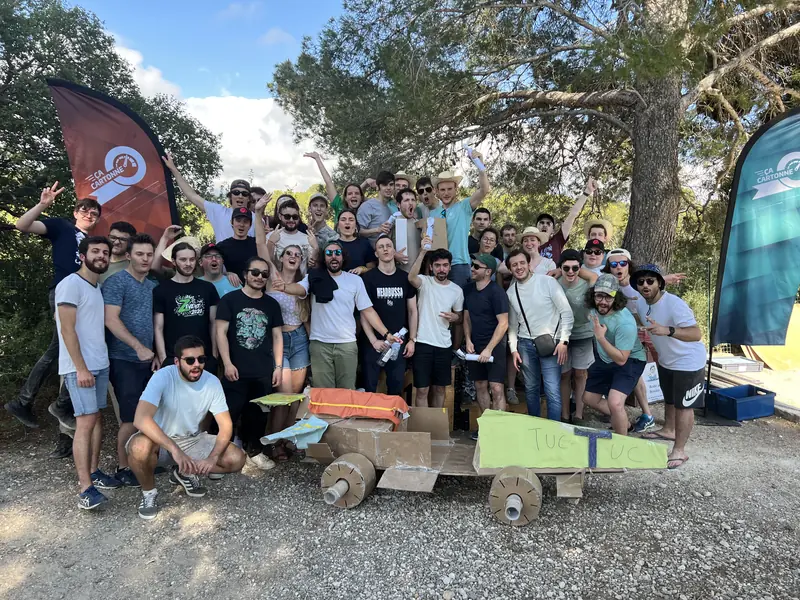


We promise, in 2000 that was a trendy name… then again, screens were 15", weighed 20kg and displayed 256 colours.
The keywords: technical rigour, human kindness.
The in-house bootcamp launches: three full-time weeks bringing everyone to the same level on the fundamentals we expect on assignment.
Our craft is recognised, and we take the time to share it: blog, conferences, meetups.
A new approach to management and a tool to share it, while the tech-watch team grows with monthly talks and brown-bag sessions.
13 conferences (Devoxx, Voxxed Days), some forty managers trained, over 600 HR highlights, and 100% of the teams briefed on tackling harassment.
Not a comms plan: an AI guild, field reports shared, and practices we write together. The tool speeds up the code; it does not decide the architecture.
Amel Mochklit and Loïc Ortola take the helm: a strategy and a positioning redefined, on the same bedrock of technical rigour.
The next part is still to be written.


Amel Mochklit and Loïc Ortola took up the torch in 2026, twenty-five years into the story — a strategy and a positioning redefined, on the same bedrock of technical rigour. The same open space as everyone else, the same discussion channels, the same architecture reviews: leadership stays within reach of a question rather than behind a door. Their job is not to arbitrate every decision — the teams handle that perfectly well — but to guarantee that technical rigour and quality of working life are never set against each other. Today the adventure brings together more than 200 people and several distinctions, among them first prizes at TechAtWork and HappyAtWork in France.
« Doing what everyone else does is no guarantee of being right. »
A culture page proves nothing. The best way to find out whether Takima suits you is to talk about it.
Join usNot a recited interview.
On the projects, the team, the follow-up… no corporate speak.
An honest read on your profile and on the market, from people who do the job.